

“Sometimes structural complexity and financial engineering
are not used to improve risk, but to hide it.”
Ares Alternative Credit Newsletter
This September marked the 25th anniversary of one of the most horrific acts of terrorism on US soil that we had ever seen. For those who lived through September 11th, 2001, those thoughts and memories will never be forgotten. For our kids, I hope they continue with the same respect and honor for our fallen friends, colleagues, and all those who fought to defend this great country. I’ll touch on this thought a bit later as we progress through what was an eventful summer.
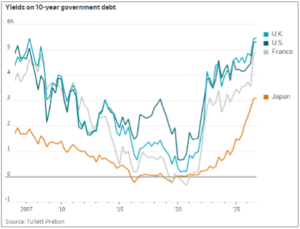
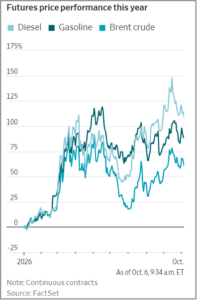
Whoever coined the phrase “Summer Doldrums” might want to coin a new phrase for the next two years while President Trump is still in office. For the first time in our history, the US gross debt hit $40 trillion and approximately 100% of our gross domestic product, with debt service now approximated at $1.1 trillion annually. That’s a big number. We also saw this summer the cost of US light sweet crude oil at $106 per barrel, US regular gasoline hitting highs of $6.50 and diesel fuel exceeding $8.00 in some parts of the country. On top of this, the US Treasury rates have been moving meaningfully higher. The 10-year US Treasury yield, a benchmark for most US mortgages, hit 5.34% along with the 30 year fixed mortgage rate at two-year high of 7.40%. Global 10-year bonds are also moving meaningfully higher and could be signaling a potential global sovereign debt crisis. Oh, and I almost forgot potential fuel shortages and the continuing Iran war.
Wow, this doesn’t sound great, does it? Most would probably say no. But we are living in one of the greatest technological revolutions of modern time, the Fourth Industrial Revolution, combined with a strong US economy. Balance sheets for consumers are in good shape, and baby boomers are continuing to spend. Just take a look at retail sales for August and you will see that the consumer continues to spend. Gross domestic product continued to grow at a strong pace in the month of August. Now look at the US Treasury bond market, specifically rates, which might be moving higher and reflecting a strong US economy. And for fuel, while it certainly hurts at the pump for the consumer, and the shipping industry is dealing with some serious challenges, fuel consumption for the consumer is much lower these days compared with years past.
After years of artificially low rates, rates might be just normalizing and adjusting to this AI-driven economy.
While we are expecting in the short term to see a pickup in volatility, we look at crisis moments and drawdowns in the financial markets as opportunities since smart and successful investors don’t look at their ski tips. They focus on the long term. Let’s circle back to September 11 for a final word. On September 11, 2001, the equity markets shut down for four consecutive trading days. Investors were scared, as was most of America. But since that horrific day, the S&P 500 has returned over 1,000% and more than 10% on an annualized basis. American capitalism has shone since that fateful day and will continue to shine throughout future challenges. Stay disciplined, remain focused on your wealth management plan, and stay connected to your team at Banyan Wealth.
Below are a few of the pros and cons we are watching:
Pros:
- The AI-Driven Boom. The biggest bet in American history.
- Seasonality is strong, especially after mid-term elections
- The S&P 500 continues to trend higher
- The forward earnings multiple of S&P 500 has gotten cheaper
Cons:
- Higher US interest rates
- Federal Reserve interest rate tightening cycle
- Energy prices and fuel – refined product shortages
- Escalation andor broadening out of the Iran war
- Private credit, interconnected fixed income exposure and risk associated with the insurance industry
A few charts we are monitoring:
As we navigate through our investment and wealth management process, it’s important that we are in touch to review your plan and adhere to your goals. As always, your confidence and trust in us are much appreciated, and if you have any questions or concerns, or know a friend, co-worker, or family member who could benefit from the guidance we provide, please do not hesitate to reach out.
Thank you,